
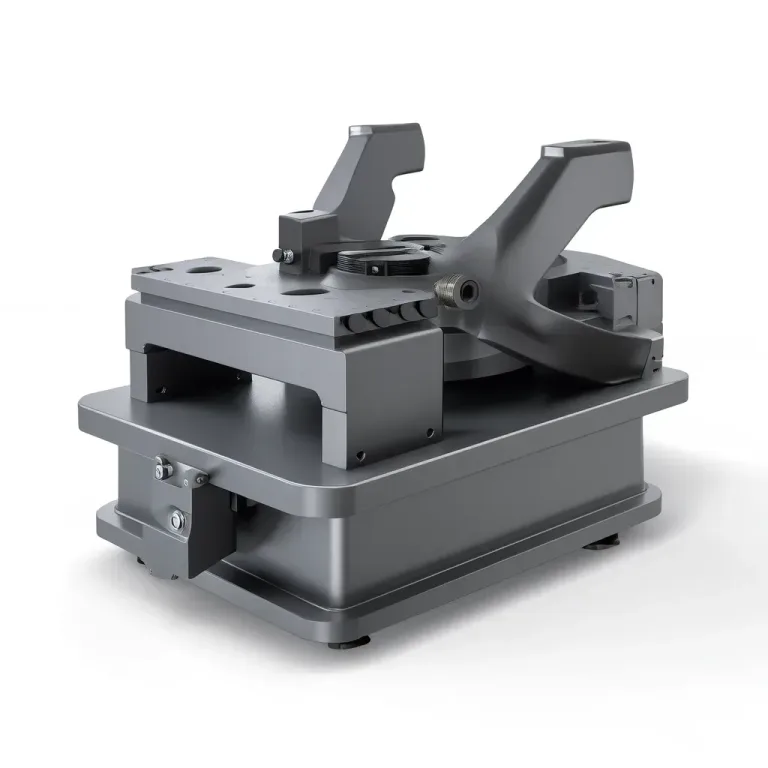
Welding Positioner
Welding positioner for rotating workpieces during welding — standard welding accessories in industrial equipment catalogs
About Welding Positioner
Welding positioner for rotating workpieces during welding — standard welding accessories in industrial equipment catalogs
| Domain | welding |
|---|---|
| Product Family | Welding Accessories |
| Engineering Function | Repositioning and rotating workpieces to optimal angles for consistent, high-quality weld deposition |
Who Works With Welding Positioner?
6 engineering roles are connected to Welding Positioner based on verified research evidence.
Maintenance Technician
Welder
Welder is a widely recognized, standardized occupational title defined by O*NET and national labor classifications. In the context of MIG welding equipment (e.g., SYNMIG 200 AMP MIG INVERTER), welders directly operate the machine, inspect weld quality, and troubleshoot operational issues (e.g., wire feed, arc stability, gas flow). The term 'Welders' is the plural form of the professional role 'Welder', not a department, company, or task.
Welding Operator
MIG welder operators are a recognized occupational category per BLS.gov, with standardized duties tied to semi-automatic arc welding equipment. While 'MIG welder operator' references a specific process (GMAW), the canonical professional role is 'Welding Operator', a broadly recognized title in manufacturing and industrial engineering. The specialization 'MIG' is valid and retained as such — it reflects a widely accepted process-specific competency within welding operations, not an artificial product-specific title. The role directly operates, inspects, maintains, and troubleshoots MIG welding machines like the SYNMIG 200 AMP unit.
Fabrication Technician
Fabrication Technician is a widely recognized industrial role responsible for operating, maintaining, and troubleshooting metal cutting equipment—including plasma cutters—within fabrication shops. The evidence confirms integration of plasma cutting instruction (calibration, kerf control, dross management) into their core responsibilities, directly linking them to the specified plasma cutting equipment. While 'fabrication' is broad, 'Fabrication Technician' is a standardized occupational title (e.g., O*NET SOC 51-4121, ISO 29002-2), distinct from generic 'technician' roles, and not product-specific (no embedded product name like 'CUT80 Technician').
Supervisor
Supervisor is a widely recognized professional role in industrial manufacturing and welding environments. In the context of welding positioners, supervisors oversee welding operations, coordinate between welders and positioner operators, verify process compliance, and ensure safety and quality — aligning with standard supervisory responsibilities in fabrication shops. While not product-specific, it is a legitimate, broadly accepted role directly involved in managing the use of welding accessories like positioners.
Machinist
Machinist is a widely recognized, standardized industrial trade role with formal apprenticeship pathways and national occupational classifications (e.g., O*NET 51-4041.00). In the context of welding positioners — rotary tables, turntables, and headstock/tailstock systems — machinists routinely install, align, calibrate, operate, perform preventive maintenance on, and troubleshoot mechanical positioning equipment. Their expertise in tolerances, fit, rigidity, and motion control is essential for integrating positioners into welding cells. While not exclusively welding-focused, their role directly supports welding operations by ensuring precise, repeatable workpiece positioning.